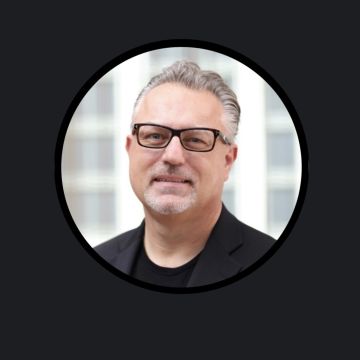
Marc Bulandr
Ordained Minister in Crystal Lake, Illinois
Why did you originally become an ordained minister online?
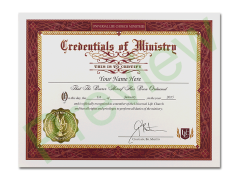
The online ordination came in November 2024 because my son Jacob asked me to officiate his wedding to Darcey. That request did not arrive in a vacuum. It arrived because Jacob had grown up watching me sing in memory care facilities, ride my motorcycle into the homeless neighborhoods of Chicago alone with a Bible to sit with people the institutions had forgotten, and stand at gravesides when families asked. He had watched me fund the floor repairs at Freeman Lutheran when the building needed them, and bring food to the Ferryville Tractor Pull every year so the Men's Group could keep its fundraising whole. He had watched a faith that had been with me since I was nine years old, the year my father died and faith arrived in my life as need before it ever became practice. The Universal Life Church credential made it legal for me to officiate his wedding. The ministry behind it was already decades old. I wrote the liturgy myself. I named the dead from both families so the living could feel them in the room. That was the work I had been preparing for my whole life.
Where are you from?
I was born in Berwyn, Illinois in 1967, the second of two boys in a Czech-American household. My father died when I was nine, which means faith and grief arrived in my life at the same time. I was baptized at Riverside Presbyterian Church on May 6, 1982, my fifteenth birthday. The date was not incidental. The next year I was ordained as a Deacon, the youngest in the congregation's history at the time. I sang in the choir, performed solos, and was given responsibility before I had earned it. That formation has shaped how I have understood ministry ever since: as something received before it is exercised. I now live between Crystal Lake, Illinois and a cabin I have owned in Ferryville, Wisconsin for twenty-six years, in the Driftless region along the Mississippi River. I have been a member of Freeman Lutheran Church there for over a decade and serve as lay worship leader at Freeman and at DeSoto Lutheran. The river and the people who live along it have shaped my voice as much as anything else.
What do you hope to achieve with your online ordination?
The ordination has already done what I needed it to do. It allowed me to officiate Jacob and Darcey's wedding. But the question of what I hope to achieve with the ministry itself is bigger than the credential, because the ministry preceded the credential and will outlast it.
Grace and Peace Studio is the visible form of what has been forming for a long time. It is the studio where my preaching, pastoral care, weddings, baptisms, funerals, custom recordings, and daily scripture work live together in one place. On Sundays, Marc My Sabbath gathers the seven days of readings into one homily, with music chosen to carry the weight. The studio is open to anyone who is asking.
What I hope to achieve is not measured in titles or credentials. It is measured in whether someone who is grieving feels less alone, whether a couple's wedding carries the weight of those who came before them, whether a daily word grounds someone before the noise of the day takes over, whether a family can sing a loved one home at the graveside. It also reaches the Harley and motorcycle community, where I serve riders, families, and clubs who carry pastoral needs most ministers cannot reach. People have approached me in tears after sermons saying I belong there. A friend wrote to me after listening to a podcast and said GOD is with us always, in every situation. Another wrote that she thinks I must be an earth bound angel. I do not say any of that to claim it. I say it because it tells me the work is real. It is reaching people. It is what I am called to.
The ULC credential remains useful when families ask me to officiate. But the work is the ministry, not the ordination.
Religious Affiliations
Baptists, Christianity, ELCA, Lutheranism, Methodism, Presbyterianism, Universal Life Church
Additional Information
A few things the categories cannot quite hold.
My faith is daily before it is denominational. I have read the Bible cover to cover twice. Each morning begins with at minimum forty-five minutes in scripture, working through multiple reading plans at once, letting the readings shape the day before the noise of the day takes over. The practice is older than the studio. It is older than the ordination. It is what gets me to the page and to the pulpit and to the altar. The work I bring to a couple's day is not improvised. It is the visible form of a daily life of reading and prayer.
My faith was forged through loss before it was a formal tradition. My father died when I was nine, the year I first understood that faith was not a feeling but a place to stand. My wife Jennifer and I lost our first child, Noah, to anencephaly. The faith that survived those seasons is a different faith than the one that entered them. I bring that to couples and families who are carrying grief into a day that is supposed to be joy. The two can hold each other, and they do.
My ministry is shaped by a sociologist's training as much as by a pastor's heart. My master's thesis at Illinois State studied how quotas and pressure distorted what police officers reported about citizen encounters, with over a hundred hours of qualitative ride-along observation. I learned early that human truth and institutional reporting are not the same thing. I have spent my life since then studying how communities, faiths, rituals, and cultures actually work, not just what they claim to be. When I officiate a wedding, I am not running a script. I am reading the family, the community, the tradition or traditions in the room, and the specific couple at the center of it. I write the liturgy out of that reading. The sociology is what lets the theology land in the room it is actually in.
Two pastors gave me my theological foundation, and both are gone. Rev. Dr. Roger Kunkel of Riverside Presbyterian Church baptized me, married Jennifer and me, and baptized our children. Rev. Dr. Wesley Fuerst, longtime Old Testament faculty at the Lutheran School of Theology at Chicago and a family friend, encouraged me toward ministry when I was nineteen. Their influence is in every ceremony I lead. I name them because no minister stands alone, and the people who taught me deserve to be acknowledged.
My posture in ceremonies is rooted but not gatekeeping. I am Christian. I will not pretend otherwise. But I am not in the business of deciding who is in or who is out. If a couple comes from different traditions, I work with both. If a couple comes from no tradition, I bring weight without imposing language. The sociology helps me know the difference between honoring a tradition and forcing it. The studio is open to anyone who is asking.
What do you think makes your ceremonies special as a Crystal Lake, IL wedding officiant?
What makes my ceremonies different is that I am not performing a role. I am bringing a life of pastoral practice into the most important day a couple will share.
I have been working with grief and joy at the same time for as long as I can remember. Faith arrived in my life at age nine, the year my father died. I have sung at gravesides when families asked, sat in memory care facilities with people who had no other visitors, prayed with strangers in airports and over bar tops, and ridden my motorcycle into the homeless neighborhoods of Chicago with a Bible and food. I have watched what carries weight at the moments that matter most. A wedding is one of those moments.
When I officiated my son Jacob's wedding to Darcey, I wrote the liturgy myself. I opened with a remembrance that named the dead from both families — Darcey's grandmother, Jacob's great-grandmother Elsie, his Uncle Ray — so the living could feel them in the room. I have learned that the people who came before are part of every wedding, whether you name them or not. Naming them is what gives the ceremony its real weight. The vows are stronger when the dead are present. The blessing is fuller when the family that built the couple is honored.
What I bring to a ceremony is what I bring to everything else. I write the liturgy by hand, in the couple's voice, after listening carefully to who they are and where they come from. I can sing, and I sometimes do, when a song will carry weight that words alone cannot. I do not perform sentiment. I do not read from a script that could have been used for any other couple. The ceremony belongs to them, not to me, and not to any template. I also officiate weddings for couples in the riding community, where the ride is sometimes part of the day and the family is sometimes a club. The pastoral instincts translate.
A wedding is the moment a couple stands inside their family's whole story and says yes to the next chapter of it. My job is to make that moment hold.
Are there particular areas near you where you prefer to travel or have special experience?
I am based in Crystal Lake, Illinois, in the northwest Chicago suburbs. My second home is a cabin in Ferryville, Wisconsin, in the Driftless region along the Mississippi River, where I have been a member of a small Lutheran congregation for over a decade and serve as lay worship leader at two congregations. The Chicago metro area and southwest Wisconsin are my home grounds. I know them well and the ministry works in them constantly.
Beyond home, the ministry travels with me. I lived in downstate Illinois through my undergraduate and graduate years at Illinois State University in Bloomington-Normal, and I still have deep ties to that part of the state. My son Jacob lives in Nashville, which means I have working familiarity with central Tennessee and a real reason to be there. For several winters Jennifer and I have spent meaningful time on the central and east coast of Florida, from Daytona Beach up through St. Augustine. That part of the coast is second nature.
Distance is not a factor when the ministry calls for it. I have traveled extensively across my career and across my life, and I am at home in airports, in unfamiliar towns, and in rooms full of people I have never met. I will travel for ceremonies, pastoral care, family moments, and ministry work anywhere in the country, and internationally if the situation calls for it. The conversation determines what is possible. Travel is part of the planning, not a barrier to it.
One more region matters, and it is not a place. It is a community. I have had my motorcycle license since I was eighteen. I am not a casual rider. I am a distance rider, and I ride whenever the season and the schedule allow. My times, I've rode my Harley across significant part of America. The Harley and motorcycle community has its own pastoral needs that most ministers cannot reach. Funerals for fallen riders. Blessings of the bikes. Weddings where the couple wants the ride to be part of the day. Pastoral care for riders carrying grief, recovery, or transitions that fellow riders understand more readily than non-riders do. I serve that community. I am at home in it. I will ride in for the work when the ride is part of the ministry.
Wherever you are, whatever your context, the ministry goes where it is asked.
Types of Service Offered
Marriages, Same-Sex Marriages, Renewal of Vows, Baptisms, Funerals, Christenings, House Blessings, Spiritual Healing, Premarital Counseling, General Ministry, Spiritual Guidance
Additional Information
Three things, briefly.
First, the ministry is open. I have been shaped by many faith traditions since 1976. I serve Christian couples and families primarily, but I am at home with interfaith ceremonies, ceremonies that draw from multiple traditions, and ceremonies for couples and families who would not call themselves religious but want the day held with weight. I do not turn people away because they belong to a different tradition than mine, or to no tradition at all. The studio is open to anyone who is asking.
Second, the work continues after the day. A wedding is one moment. A baptism is one moment. A funeral is one moment. The pastoral care that surrounds those moments is what makes them durable. I am available to couples, parents, and families after the ceremony, not just during it. Some of my deepest pastoral relationships started with someone reaching out months after I had stood with their family at a graveside or a wedding altar. That is welcome. That is what the ministry is for.
Third, this is not a side practice. Grace and Peace Studio is one of two companies I am building full-time since I left enterprise technology in February 2025. The other is Qualitative Intelligence Systems in healthcare data and AI. Both sit under Marc Bulandr Media + AI. The ministry is not what I do on weekends. It is half of what I do, period. When a family hires me, they are getting someone whose work is full-time and whose voice has been forming since I was nine years old. Faith. Family. Work. That is the order. That is the life.
If any of this resonates, the door is open.